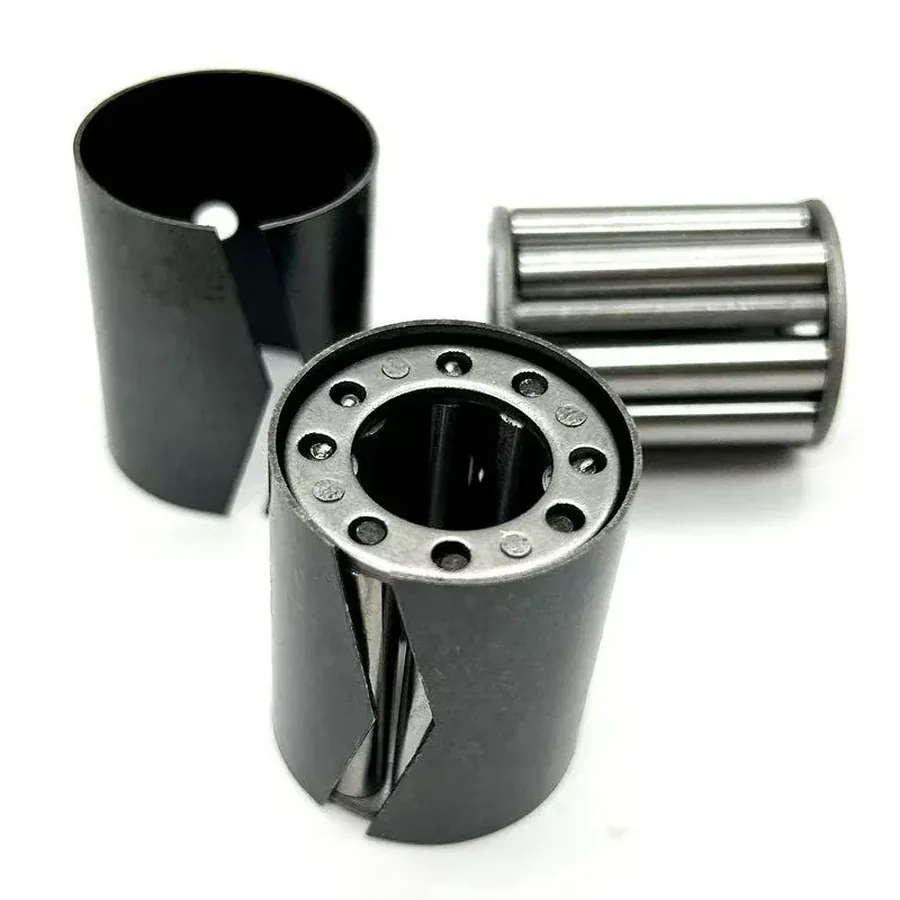
The environment decides the material.
The catalogue does not.
A bearing that fails in service rarely fails because the steel was wrong in general. It fails because one condition was never named: a cleaning agent, a warm housing, a vacuum, a current passing through the ring. Material selection starts from that condition.
Each material fails in its own way.
The choice is not a ranking of quality. It is a choice of which failure mode the application can tolerate and which it cannot.
| Route | Where it earns its place | How it usually fails |
|---|---|---|
| Through-hardened bearing steel | Load, stiffness, machine tool and gearbox duty | Corrosion in washdown, softening once the working temperature passes its tempering range |
| Martensitic stainless | Corrosive media, clean rooms, food and medical handling | Lower load capacity than bearing steel, and hardness falls sooner as temperature rises |
| Silicon nitride ceramic | Non-magnetic or insulating duty, high speed, aggressive media | Brittle under impact, sensitive to fit and to any distortion in the housing |
| Hybrid, ceramic balls in steel rings | High speed, low friction, protection against electrical erosion | Rings still corrode, so the housing environment still decides the life |
| Special alloys and coatings | A named medium or a narrow temperature band, confirmed case by case | Availability, and the coating becomes the wear surface that has to be inspected |
Stability, not just resistance
A ring that is not stable at the working temperature grows in service and loses the preload that was set at assembly.
Hardness has a ceiling
Above the tempering range the raceway softens, and load capacity falls with it even though the part still looks serviceable.
The lubricant goes first
Grease or oil usually fails before the steel does. In most applications the lubricant, not the material, sets the temperature limit.
Five conditions that change the answer.
These are the questions asked before a material is proposed. An answer that skips one of them usually comes back as a claim that cannot be tested.
- CorrosionWhich medium, at what concentration, wet or vapour, and how often the part is cleaned.
- VacuumPressure, outgassing limit and the lubrication route that survives dry running.
- CleanlinessParticle limit, washing method, and packing that keeps the part clean until it is fitted.
- Food and medical contactThe lubricant and materials the application itself can accept, not only the bearing.
- Low temperatureToughness of the ring at start-up, and whether the lubricant still flows at that point.
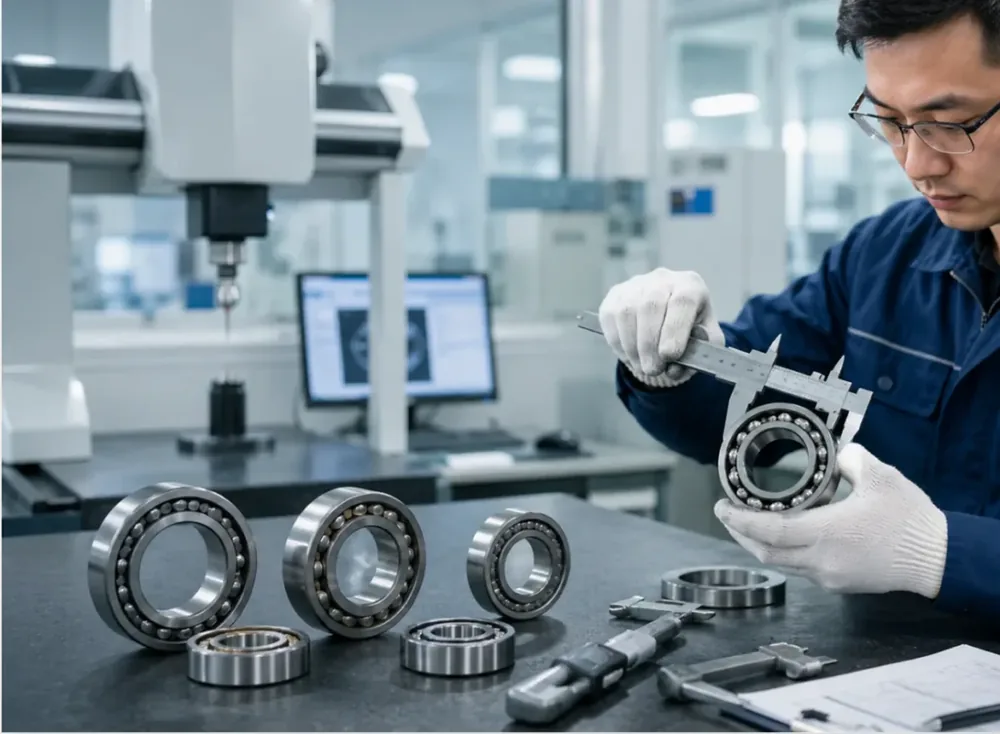
What is asked before a route is proposed.
The judgement column is the part that matters. It names what actually decides the life, which is often not the material grade alone.
| Condition | First question | What decides it |
|---|---|---|
| Continuous high temperature | Is the temperature continuous or cyclic, and what is the peak | Heat treatment stability and lubricant life, not the steel grade alone |
| Corrosive medium | Which medium, at what concentration, and does it reach the raceway | Stainless or coating, and whether cage and seals survive the same medium |
| Vacuum or clean room | Pressure, outgassing limit and lubrication method | Dry or solid lubrication, plus a cleaning route before packing |
| High speed | Speed, cooling and the load the cage has to carry | Cage material and guidance, running accuracy, and the heat path out of the rings |
| Non-magnetic or insulating | Field strength or voltage present in the assembly | Ceramic or hybrid, and a fit that accounts for the different expansion |
| Low temperature | Start-up temperature and thermal shock | Ring toughness, and a lubricant that still flows when the machine starts cold |
Where the environment is new, the first step is a sample.
A material that works in one medium can fail in a mixture of two, and a temperature that is harmless in air can attack a lubricant in a sealed housing. Where the combination is not covered by earlier work, the first step is a sample under the stated conditions rather than a batch order.
The review returns the proposed route, the reason it was chosen, and the points that still have to be tested. Where a medium or a temperature cannot be supported, that is stated before anything is quoted.
Send the medium and the temperature
Name the medium before the material.
Temperature, medium, cleaning and the environment around the housing decide the route. The drawing then decides the geometry.